Friday, June 3, 2022

Welcoming Beneficial Wasps Into the Garden


A Blue Mud Dauber among the Milkweed. Photo Copyright Daniel E. Levenson 2022.


June 3, 2022

One of the more delightful things about creating pollinator gardens, and generally replacing lawn grass or alien ornamental plants with native plants is that it’s not only butterflies and hummingbirds that show up, but a really interesting range of other types of pollinators which are perhaps less commonly noted by the casual gardener. As I’ve built up the native plant and pollinator gardens around my yard these last three years I’ve been endlessly fascinated not only with the  perhaps expected Ruby-Throated Hummingbirds that stop by on their daily rounds, or the Monarchs on the Milkweed, but by the range of other kinds of pollinators which are drawn to this little patch of native plants.

One of the first visitors I began to notice last summer once the Milkweed and Bee Balm was in bloom were two species of solitary wasps: Blue Mud Dauber (Chalybion californium) and Golden Digger Wasps (Sphex ichneumonea), both of which seem to be well-established in and around the back garden. These two species are generally not aggressive towards humans, but if you’re grasshopper in the case of the latter, or another species of mud dauber in the case of the former, it would be prudent to exercise caution: The Golden Digger Wasp hunts, paralyzes, and provides grasshoppers as food for their offspring inside a sealed tunnel, and the Blue Mud Dauber is known for finding its way into the nests of other species of Mud Dauber where, not unlike our local Brown-Headed Cowbirds with respect to other songbirds, it then removes the eggs of its near relative and leaves behind its own, using parasitism as a strategy for survival. Although I’ve yet to see these two creatures in the garden this year, my guess is it’s still a bit early, and as the Common and Swamp Milkweed in the garden move closer to flowering, these species of beneficial insects will once again be buzzing around the flowers.

Copyright Daniel E. Levenson 2022.

Wednesday, June 1, 2022

Woodrow Dines on The Deck


Our resident Woodchuck decided to try something new this evening, snacking on some potted violets on our back deck.

June 1, 2022

Some of the animals that show up in our yard are undoubtedly passing through, on their way to or from some other woodsy place in town. The doe and her fawns, the rowdy group of male Wild Turkeys, the coyotes we hear at night - they wander through on their way to somewhere else and we are content to see them as they appear. With others, though, we clearly share this little patch of suburban forest, and the dean of the hyper-local inhabitants is undoubtedly our resident Woodchuck, whom we have named Woodrow. Our first summer here Woodrow made regular appearances in the backyard during the day, munching on grass and other greens, waddling cautiously from one place to another in his little fiefdom, and then the second summer he was conspicuously absent. This spring Woodrow has appeared again with some regularity, and this evening he surprised us by climbing the few steps beside the back pollinator garden onto our deck, where he dined on some potted violets. It was hard to tell if he found them very palatable, for a minute or two into his meal he stood up, turned, and galloped, in a fashion, back toward his burrow beneath the shed.

Many people who covet picture perfect lawns curse the Woodchuck, and I admit, should Woodrow turn his attention to excavation close to the house I may need to have a serious conversation with him, but as a fellow inhabitant of this land, I enjoy watching him as he goes about his daily business, ambling through the grass in search of tasty things to eat.

Copyright Daniel E. Levenson 2022


Tuesday, May 31, 2022

Rewilding Suburbia - Part 1

May 31, 2022


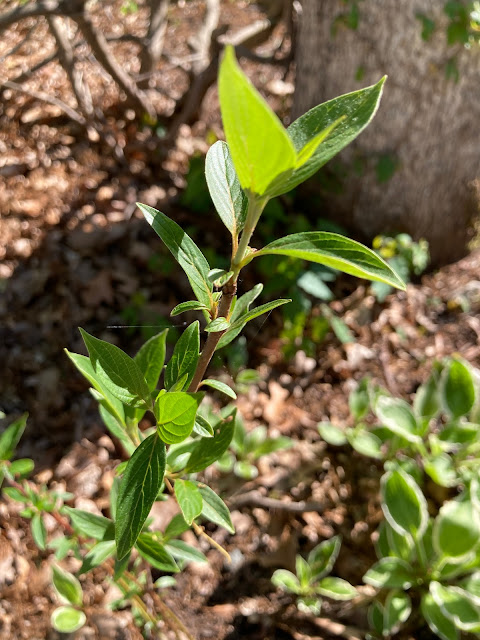
In order to help make our yard more attractive to wildlife and give the landscape a more natural feel we've been adding not only smaller flowering plants, but native trees and shrubs as well, including this Silky Dogwood shrub (cornus amomum). This plant arrived in bare root form from Prairie Moon Farms and went into the ground last autumn. In order to give it plenty of room to spread out I cut back a rhododendron that was running wild across an old flower bed. When fully mature, this shrub should reach 6'-10' feet in height. Photo Copyright Daniel E. Levenson 2022.

It’s been quite some time since I last posted anything on this blog, and to be honest, many other writing projects have come and gone in the intervening period, and the efforts I put into this nature blog had faded from memory. In fact, I think I pretty much forgot it existed.

And then we were hit by a global pandemic in early 2020, and to escape the depressing claustrophobia of life largely confined to home I turned my attention to writing about the natural world once again, turning early morning forays to little ponds and suburban parks into short essays I collected in a manuscript. That manuscript still sits on a hard drive, because when I went back to read it and edit it, I found it rather depressing. Then I started to write something else, but that petered out as well. Such is the act of writing I suppose. As any honest writer will relate, their files - be they physical, digital, or mental - contain far more half-finished pieces and scraps of ideas than ever see publication.

Part of what drove the first year pandemic nature essay project was a desire to give myself the (admittedly delusional) goal of creating a sense of control in a world that felt like it was fraying at the edges. In terms of structure, this effort was designed to reflect not only the similarities and differences I saw in the landscape between and among the seasons, but to try and capture the edges where they overlap - seasonal ecotones one might call them, I suppose.

For now, that work sits on a shelf. I may return to it one day, or I may let it remain as it is, a raw account of a year spent seeking solace in the forests and meadows close to home.

In the meantime one of the most exciting ongoing projects I’ve embarked upon has been a small-scale rewinding effort in the yard around my home. In broad strokes, this effort has been comprised of several key elements:

  1. Removing alien-invasive plants
  2. Plating species of plants native to the eastern US and specifically New England, including various Milkweeds, Asters, Lupine and others, and allowing native plants to fill in open spaces on their own
  3. Using organic gardening techniques to encourage the growth of native plants to improve the soil,  and avoiding the use of gas-powered mowers, blowers, etc.
  4. Adding brush piles, bird feeders, bird baths, and allowing snags to stand (when and where safe)

The removal of alien-invasive plants is admittedly a frustrating aspect of this work, because, as the name implies, these plants have not evolved along with our native plant communities or in concert with out local wildlife or other conditions, and so they wreak havoc on the inner workings of local habitats. Many of these plants seem to thrive in their new homes, as they hav practically no natural controls to keep them in check. 

While this yellow bloom may look nice - and undoubtedly it adds a nice pop of color in its native land, this Creeping Buttercup (Rananculus repens) has ranged beyond its historical borders and spread aggressively as an invasive plant in the United States. Photo Copyright Daniel E. Levenson 2022.

Unlike some of the naturalized plants which remain reasonably in place and at least have the decency to provide shelter for birds and bugs, these alien invasive have few redeeming qualities in comparison. Whether artifacts of ornamental imports or stowaways from the dawn of global shipping, the Japanese Knotweed, Oriental Bittersweet and Garlic Mustard I regularly try to eradicate often defy my best efforts. In fact, part of me wonders, as I remove patches of grass and hack away at the rhodedendrons to make more room for the Silky Dogwood that entered the earth as a bare root plant last fall, whether I’m disturbing the soil and inviting in the poison ivy (native, but not near the house, thank you very much) and its more noxious compatriots into new parts of the yard.

Nonetheless, I shall continue to pull them up.

The more time I spend on this aspect of rewinding the more I realize how little all of us - myself included - often know about our native plant communities, and frankly lack the ability to really understand the roles that different plants play. Such ignorance often leads to all sorts of wrong-headed thinking.

The concept of “weeds” is a good example - what we might think of as “weeds” are often in fact native plants which may have lacked agricultural value or appeared “untidy” to the modern gardener.  Ironically, many people are quick to mow down (literally and figuratively) the native plants that will help to improve their soil and the overall quality of their immediate natural environment, believing that they are making their yard “better.” Then, in place of these plants which have evolved over millennia to thrive in concert with their fellow native flora and fauna, many people are quick to lay down hyper-thirsty grasses which are ill-suited to our suburban lawns. To the ignorant eye these acres of yard may look nice, but in reality they are often utterly devoid of life, true wastelands.

On a positive note, however, I have found that when I’ve made space for these native plants they often find their way back, springing up where undoubtedly their ancestors once stood tall in the sun. Human intervention is admittedly helpful in order to have these returning plants thrive. I’ve spent my share of time clipping bindweed that’s wrapped itself around the Bee Balm, or pulling up cinquefoil that’s edging its way a bit too close for comfort around the Swamp Milkweed in the back pollinator garden.  One of my favorite plants that popped up during the first summer was American Pokewood, a thick green stock with lovely purple berries that is toxic for mammals but a critical  food source for migrating birds in the fall. Along the edge of the house wild raspberries have also lifted themselves up from the soil, and I’m hopeful that even if we don’t get to enjoy the fruit, the local wildlife will.

This is of course part of the thrill of this endeavor, first we see what native plants might return on their own or thrive when planted in the right spot, sunny or shady, damp or dry, according to their preference. And once the plants begin to thrive the pollinators take notice, drawing in the butterflies, moths, flies and hummingbirds which bring life back into this space that was once a patch of grass.

Copyright Daniel E. Levenson 2022.


Friday, December 26, 2014

Late December at Chestnut Hill Reservoir

With unusually warm weather in New England this late fall and early winter, some of my go to places for ducks have not been as productive as usual. I'm guessing this has to do with an abundance of open water this year, while over the last few years most lakes and ponds have been frozen in December, thus helping to concentrate the birds in the few places that are not iced over. In any event, yesterday the temperature was hovering around an unseasonably balmy 60 degrees, so I headed to one place where I've always had pretty good luck, regardless of the weather: Chestnut Hill Reservoir in Boston, MA.

Although I don't go birding there perhaps as often as I should, I do find that whenever I make the time to walk around the reservoir I'm usually rewarded with lots of ducks and this time was no exception. As soon as I approached the parking area I could see several groups of different size ducks floating on the water, so I had a good sense that I would put together a reasonably diverse list. For whatever reason the reservoir was extremely low, exposing lots of rock formations which I had never seen before. Some of the birds took advantage of these newly exposed perches, including a solitary Great Blue Heron standing tall among a group of Canada Geese out toward the middle of the water.

While there were probably in excess of 150 Canada Geese in the area, the most abundant duck of the day were the Ruddy Ducks - I counted approximately 100 of these small diving ducks and I'm guessing there were likely more. They were clumped up in several rafts around the edge of the reservoir, sometimes mixing in with the Mallards and the occasional Hooded Merganser. During my walk I also ran into two other birders who were kind enough to alert me to the presence of an (American) Green-winged Teal and a male Northern Pintail. The teal was hanging out with a few Mallards in a little corner, and it was neat to see these two species side by side and observe the noticeable size difference between the two up close. The Northern Pintail was especially exciting to see - it was very close to the shore (maybe 15 feet away from me) and in gorgeous, bright plumage. While I've seen pintails before on Plum Island, I had never gotten this close to one.

All in all I spent an hour walking around the Chestnut Hill Reservoir, enjoying the strange weather and seeing some beautiful birds. Not a bad way to spend a December afternoon.

My complete list for this outing:

Blue Jay
Mourning Dove
Canada Goose
Hooded Merganser
Ruddy Duck
Mallard
Common Merganser
Green-winged Teal (American)
Great Blue Heron
Northern Pintail
Gull Sp.

Copyright Daniel E. Levenson 2014.


Sunday, May 4, 2014

Yellow Warblers arrive at Nahanton Park


It's wonderful to be able to look out the window and see bare branches filling in with bright green leaves - not only does it do much to lift my spirits after a very long, cold winter, but it also means that more and more migratory birds should be showing up in the wetlands, forests and rivers. This past week I had a chance to get over to one of my favorite places in Newton to go birding, Nahanton Park. This is a great birding spot because it has a nice mix of open meadow, forest and community gardens which attract a range of birds, from warblers to grosbeaks to swallows. it's a nice place to visit year-round, but I especially love it in the spring when the air is full of birdsong.


Two male Downy Woodpeckers inspect a tree trunk at Nahanton Park in Newton, MA. Image copyright Daniel E. Levenson 2014.

Wandering through the lower gardens I was surrounded by the singing of male Yellow Warblers. these small, bright yellow warblers with crimson streaked-chests have a distinctive appearance and song, and are often found in brushy, wet habitat. There was also a gray catbird singing from a hidden perch in some low trees and shrubs, letting loose it's incredibly varied, complicated song. While the Yellow Warblers were the only warblers I encountered there, this is usually a pretty good spot for other warblers, including Black and White. Now that spring is finally here I'm looking forward to more birding at Nahanton Park and adding new species to my list for this location.

Thanks for reading.

Copyright Daniel E. Levenson 2014.


Friday, April 25, 2014

Birding Florida, part 2


A Tricolored Heron wades in the shallows at Wakodahatchee Wetlands in Palm Beach County, Florida. Image Copyright Daniel E. Levenson 2014.

One of the most beautiful and productive spots I've ever been birding has to be the Wakodahatchee Wetlands, a gorgeous and easily accessible park with a long, winding boardwalk that takes visitors over and through a remarkable mix of marsh, pond and edge habitat filled with a wide range of avian and reptilian life. We were very lucky to get there on a bright, beautiful morning, before the park got too crowded and I was struck right away by the abundance of birds everywhere, from Tricolored Herons to Common Gallinule and Anhinga.


The boardwalk at Wakodahatchee Wetlands offers prime viewing of an amazing range of birds and other wildlife, including alligators. Image copyright Daniel E. Levenson 2014.

I was particularly excited to see the Tricolored Herons, a new life bird and one that I was able to see up close from the boardwalk. The air above the boardwalk was alive with the flapping wings and awkward flight of Anhinga moving from one tree to another, and in the vegetation there were plenty of Little Blue Hersons, Green Herons and Blac-Crowned Night Herons on the lookout for their aquatic prey. We were also lucky enough to get a really good look at a pair of Blue-Winged Teal, a bird I had only previously observed at a distance.

An Anhinga in a tree gathers vegetation, presumably for a nest. Image copyright Daniel E. Levenson 2014.
Overall this was one of the best places I have ever been birding and would highly recommend it to both beginning and advanced birders -  the opportunity to see a range of wading species, ducks and other birds up close which are normally difficult to spot is not only a lot of fun, but also affords the chance to sharpen ID skills and observe a range of behaviors, from feeding to nesting. I know I can't wait to get back.

Copyright Daniel E. Levenson 2014.

Unexpected Owls

Now that the snow is gone, the ice has melted and the trees are once again bursting forth with buds, leaves and birds, I find myself itching to get back out into the woods and onto the water. Just this past week I spent some time birding at Moose Hill Wildlife Sanctuary in Sharon, MA, where I was delighted to see early returning migrants, including metallic-blue Tree Swallows hunting in swooping arcs over meadows, their liquid chirps filling the air. The Eastern Phoebes were also around, perched conspicuously on still-bare branches at the edge of a field, tails bobbing.

Along the boardwalk the skunk cabbage was starting to emerge from its long slumber beneath the frozen mud and as I walked along I suddenly heard, very distinctly, the sound of a Barred Owl calling in the distance to my left. I paused, listened again, and there it was  - repeating - at first I thought perhaps someone was playing a recording of a Barred Owl, but then I heard another one calling from the other side of the boardwalk. I have heard these birds many times at night, and their distinctive "Who cooks, who cooks for you ?" call is one of the easiest for me to remember. Beginning birders are often told that if they hear hooting or cooing during the day, its most likely a dove or pigeon, but this was definitely two Barred Owls making their presence known, in broad daylight.

After a little research I learned that it is actually not uncommon for these highly territorial, non-migratory birds to call during the day. I was positively delighted to learn this new fact about Barred Owl behavior, something I wouldn't have known if I hadn't had the strange experience of standing on a boardwalk in a wetland in the middle of the day and been taken by surprise by the calls of a bird I know well in another context. This is what I love about birding and outdoor exportation in general - there is always something new to discover and explore, and one never knows when one of these moments will occur.

Thanks for reading.

Copyright Daniel E. Levenson 2014.