Sunday, May 12, 2013

A walk in the park


A group of birders scan the soccer field and treeline for warblers, grosbeaks and other spring arrivals at Nahaton Park in Newton, MA. Image copyright Daniel E. Levenson 2013.
Birds almost never seem to mind the rain, which is one of the things I really like about them. Even when the weather is damp and overcast they still go about their business, finding food, building nests, singing their songs. And so this morning, even though most sensible people were still dry in their beds at 7 AM, I headed over to Nahanton Park in Newton, Massachusetts for a bird walk co-sponsored by the Newton Conservators and the Friends of Nahanton Park. We were fortunate enough to have two knowledgeable guides who were able to not only point us in the right direction to see many beautiful birds, but were also well-versed in birding by ear, picking out the tunes of individual species from among the forest chorus.

We started off the morning under some leafy trees scanning the parking area near the Charles River Canoe and Kayak rental dock, watching Warbling Vireo, Yellow Warbler and Black-and-White Warblers move in short, semi-hidden bursts in the canopy. These smaller birds were also joined by a number of vociferous Baltimore Orioles proclaiming their presence from the tree tops and an unseen Red-bellied Woodpecker which called frequently from the woods.

Flowering trees and shrubs provide food for insects, which in turn attract hungry birds. Image copyright Daniel E. Levenson 2013.

I was particularly keen to try and add a few more warblers to my list today - I think it's not just that they're interesting and colorful birds to watch which make them objects of such intense pursuit on the part of birders, it's also the fact that the majority are travelers just passing through, here for a week or two and then gone again. As we emnerged from the trail one of the leaders saw a Northern Water Thrush, which would have been a great addition to my list, but I missed it. Then someone else heard a Black-throated Blue Warbler, one of the first warblers I ever added to my life list a few years ago when I found one in a tangled section of brush at Stony Brook Wildlife Sanctuary in Norfolk, MA. Today I didn't hear it's song, but about 45 minutes later we spotted one, bringing my year list to 131 species.

The Black-throated Blue Warbler was followed by a Wood Thrush, number 132 and finally toward the end of the walk a female Rose-breasted Grosbeak brought me to 133 for the year. In total I saw 34 species of birds topday, including many Gray Catbirds and Baltimore Oiroles which seem to have shown up en masses toward the end of last week. Up until about the middle of the week I hadn't seen any birds of either species, and then it was like someone had opened up door and they came flooding into eastern Massachusetts. I can't wait to see what follows next.

Thanks for reading.

Copyright Daniel E. Levenson 2013.


Saturday, May 11, 2013

My birding big year reaches 130 species at Broadmoor WLS in Natick

A frog sits on a mossy, half-submerged log at Broadmoor Wildlife Sanctuary in Natick, MA. Image copyright Daniel E. Levenson 2013.
By dint of some miracle I was able to get myself up this morning before 7 AM. Though I suppose in reality I know what the reason was: Warblers.

It's almost like I can sense their presence in the newly green leafy canopy surrounding parks, fields and wetlands, and with so many reports of these delightful migrants passing through the area I woke up excited to begin the day looking for them. So with these tiny colorful migrants on my mind I drove over to Broadmoor Wildlife Sanctuary in Natick, MA with a quick stop along the way at Whole Foods in Wellesley to fuel up for my morning walk.

An Eastern Phoebe sits on a fence post. These birds can often be found near water where they hunt insects from an exposed perch. Image copyright Daniel E. Levenson 2013.

The weather seemed unsettled today - a bit rainy and overcast in the early morning, then cool and damp,  and finally warm and humid with the sun trying to peek through the gray blanket above. The trails were soft underfoot and the rocks and roots slippery from overnight rain. The birds, however, did not seem to mind as all. Although I tried to find new warblers that I haven't seen yet this year I only managed to see Yellow Warblers, typically one of the first to return and therefore already on my list. However I did mange to find a yellow Warbler nest, which was pretty neat. It was in some brush near the boardwalk and I'm sure I never would have found it had I not been following the flight of a female Yellow Warbler as she returned to it. I only saw one other person when I first arrived, otherwise the woods belonged to the birds and frogs, a spring-time chorus only interrupted occasionally by the sound of gunshots from a distant shooting range.

An Eastern Kingbird perches on a branch in the old orchard at Broadmoor WLS in Natick, MA. Image copyright Daniel E. Levenson 2013,.

While the warblers declined to cooperate today I did see many other interesting birds and plants. The Baltimore Orioles were especially active, with males singing loudly from trees near the boardwalk and by the wildlife observation pond. I have heard these birds call many times before but I never really paid attention to their song until today, when I heard a beautfiul four or five note tun coming from within a leaf-covered tree. Something about the birds voice made me think of an oriole, but it wasn't until I spent some time following the sound that I confirmed that it was in fact a male Baltimore Oriole calling. it's a pretty distinctive sound - if you'd like to hear an audio clip of one of these beautiful birds belting out its best the good folks at Cornell University's e-bird have compiled a collection of audio clips that you can listen to if you you can click here.

Like any good walk in the woods, today's outing left me with the sense that I was only seeing a very small sliver of the life and activity around me, not to mention more questions than answers. Perhaps chief among them was the mystery of why a Canada Goose nest I had seen an adult bird sitting on during my last visit to Broadmoor was now unoccupied, with several evidently undamaged eggs sitting in it, right out in the open.  This is a nest I have photographed before and I remembered thinking that the geese had chosen a good place to construct it, on a relatively flat, dry rock in the pond.

This Canada Goose nest on top of a rock in a pond at Broadmoor appeared to have been abandoned. Image copyright Daniel E. Levenson 2013.

I would love to know if anyone else has observed this phenomenon in New England and would welcome any ideas people might have about factors that could cause geese to abandon their nest.

One of the more exciting finds of the day was my sighting of a Pileated Woodpecker, a bird I've been trying to add to my year list for at least a month now. On the west coast my favorite woodpecker is the Acorn Woodpecker, a semi-comical looking bird that likes to sit on top of old telephone poles and caches acorns in the sides of the poles and in trees by hammering them into the wood with their bill. On the east coast my favorite woodpecker is the Pileated, a large, striking bird with a great red tuft which hunts for Carpenter Arts by whacking away at logs and tree trunks. If you haven't seen one of these birds in the wild I highly recommend looking for one. In the meantime, if you'd like to see a few photos and learn something about these birds, you can visit this National Geographic webpage devoted to them.The Pileated Woodpecker was species number 130 for me for the year in New England.

I'm hoping my year list will get a significant boost from the upcoming Mass Audubon bird-a-thon, when I will join the Drumlin Farm team on a quest to see as many species as we can in 24 hours on Cape Cod, an experience I definitely plan to share here on the New England Nature Notes blog.

Thanks for reading.

Copyright Daniel E. Levenson 2013.


Friday, May 10, 2013

The Warblers arrive


Stony Brook Wildlife Sanctuary in Norfolk, MA offers a wide range of habitat to explore, including open fields, forest and extensive wetlands and ponds. Image Copyright Daniel E. Levenson 2013.
As I read reports this afternoon of birders finally finding Warblers in Massachusetts I couldn't wait to get outside and try to add some more names to the list for New England birding big year. By noon I was reading reports on the ABA Massachusetts list of all kinds of warblers and other spring arrivals, and by 2 PM I was in Norfolk, MA at the Stony Brook Wildlife Sanctuary and Bristol Black State Reservation, two adjoining properties south of Boston which offer great birding, with a mix of habiat including mixed forest, wetlands, ponds and meadows. I've seen lots of interesting birds here over the years and the boardwalk which runs through the pond and marsh area is a great place to see ducks in winter and herons, Red-winged Blackbirds, Swallows and the occasional Osprey in the summer. In total I saw 27 species of birds this afternoon, including 5 more species that were the first of the year for me.

Canada Geese with goslings. Image copyright Daniel E. Levenson 2013.
As I walked around the sanctuary the woods and meadows were alive with birdsong and the fluttering of wings as I watched Tree Swallows chase each other over an open field, Canada Geese shepherd their goslings as they ate vegetation and Common Grackles fly in graceful swoops from one tree to the next. In one of the first places I stopped to look and listen I soon heard a familiar call and looked up to see my first Chimney Swifts of the year high overhead. I took this as a good sign, and soon enough a male Baltimore Oriole appeared singing from a branch near one of the ponds. Between the Tree Swallows, the Red-winged Blackbirds and the oriole, I felt like spring was really here.

Near one of the small dams I heard some rustling in the grass and stopped to investigate. I thought I might find a sparrow or two, but there was something about the sound of the movement that made me think it might note be a bird - and in fact, it wasn't - as I looked carefully in the grass I saw that it was a Northern Water Snake, not a new bird for the year list of course, but the first of its species I've seen tin 2013.

A Northern Water Snake at Stony Brook WLS in Norfolk, MA. This species of snake is found throughout the northeastern US and preys on a range of small creatures, including salamanders, fish and small mammals. Image copyright Daniel E. Levenson 2013.
I continued my walk and arrived at the boardwalk, which took me far out into the wetland area and to a small island where I added two more species to my big year effort - a Common Yellow-throat and a Black-and-White Warbler. At this point I was beginning to feel like perhaps the expected tide of warblers had actually arrived and was excited to look for more of them. I took my time coming back over the boardwalk, pausing to watch one of the resident Mute Swans glide past and checking the underbrush for sparrows.

I finished up the afternoon on the other side of the sanctuary where I walked quietly through the forest pausing every few minutes to look and listen.In the woods I saw an American Goldfinch high in the treetops and lower down I saw my first Ovenbird of the year, bringing my New England big year birding total to 129 species.

Copyright Daniel E. Levenson 2013.

Wednesday, May 8, 2013

3 More species bring my New England birding big year total to 124


Nahanton Park in Newton, Massachusetts. Clear, pleasant weather followed by wind, rain and fog can cause migrating birds to stop and wait out the bad weather in parks and other green spots along their routes. Image copyright Daniel E. Levenson 2013.

For the last week or so we have had phenomenal weather here in Massachusetts, with consistently clear, blue skies and little humidity. It's been great being outside and enjoying this unusually pleasant weather, but when I saw that rain would be moving in toward the middle and end of this week. I got even more excited. My hope was that with the nice weather for the last week and the sudden arrival of rain, wind and fog that we would get what birders call "Fall out," a condition when migrating birds take a break from their journey and hunker down wherever they happen to be while they wait out the bad weather, so I drove over to Nahanton Park in Newton, Massachusetts. I was really hoping this might help me with my warblers - so far I only have 4 species for the year, which will probably really hurt my overall number for my New England birding big year. Unfortunately the only warbler I saw was a Yellow Warbler, a bird that is already on my year list. Despite the lack of warblers I had a nice time and managed to add 3 more species to my year list, bringing my total to 124 species for the year to date.

The first addition to the list came as I was standing near the parking area scanning the sky above the field, watching Tree Swallows hunt insects on the wing. These small, gregarious birds are one of my favorites to watch, especially as they swoop through the air over meadows, ponds and wetlands. As I was watching them I realized that one of the birds was different from the others and I began to track its flight through my binoculars. After quickly consulting my Sibley's field guide for a refresher I was certain that I was looking at a Northern Rough-winged Swallow. The bird was just as fast as the others, but uniformly brown on top, with a brown head, white underside and brownish tail. Not long after that I decided to explore a patch of brush and trees near one of the garden plots and heard a familiar rambling series of notes coming from the underbrush. I stood listening, trying to figure out if it might be a Northern Mockingbird when the animal in question flew up and landed on some vines, revealing itself to be a Gray Catbird, my first for the year. These two birds increased my New England birding big year list count to 123, but I wasn't done yet.

A Tree Swallow pokes its head out from inside a nesting box at Nahanton Park in Newton, Massachusetts. Image copyright Daniel E . Levenson 2013.
 There was plenty of activity going on all around me as I walked toward the soccer field and along the narrow path that leads to down the river: Song Sparrows were letting loose their out-sized tune, Common Grackles were creaking and wheezing in the tree tops and American Robins made themselves known through their distinctive squeaking call which always reminds of a dog toy. In past years this section of the park has been a good place to see a range of birds, including the first Rose-breasted Grosbeak I'd seen. There may have been a warbler or two hidden in the tangle, but any clear views eluded me. Over by the Charles River, where Charles River Canoe and Kayak has an on-site rental location I saw a number of birds moving quickly in the branches of a leafy tree and moved closer to investigate. First I saw two Eastern Phoebes - possibly a pair - they didn't seem overly concerned by my presence and sat mostly exposed, flicking their tails ever few seconds, in true phoebe style. Then I noticed a couple of Chipping Sparrows among the leaves. What really caught my attention, though, were two drab little birds, gray on top, white underneath with a hint of a yellow wash along the side and a whitish eyebrow. I watched them for a while as they moved from one branch to another grabbing insects from the leafy, flowering branches. After about ten minutes I knew I was looking at species #124 for the year, Warbling Vireo.

Kayaks and canoes wait to be used by paddlers near the Charles River in Newton, MA. Image copyright Daniel E. Levenson 2013.
As the light started to fade the chorus of frogs from the pond and river stepped in, taking the place of  grackles and robins, and the little clouds of insects overhead grew into bigger clouds of insects. Under the darkening sky I walked back to the parking area and stood for a while watching the Tree Swallows over the field. It was a nice way to end the day.

Thanks for reading.

Copyright Daniel E. Levenson 2013.

Tuesday, May 7, 2013

A spring morning in the Boston Public Garden

A Canada Goose paddles into the shade of a Willow Tree at the Boston Public Garden. Image copyright Daniel E. Levenson 2013.
Late this morning I managed to get outside for a short visit to the Boston Public Garden, which is truly one of the more beautiful urban green spots I have encountered in the city. Over the last few months I have seen a number of different species of birds here, including House Finches, a Red-tailed Hawk, Blue Jays, Red-winged Blackbirds and Common Grackles. Throughout the winter a group of apparently resident Mallards also hung around (joined by one all-white Pekin Duck) swimming in open water when it was available and huddling at the edges of the ice when the temperatures dropped. I'm guessing that the Public Garden is a good migrant trap, but I haven;t had the opportunity yet to spend any time there with binoculars. On my visit today I saw many of the expected birds, including Canada Geese, Mallard, Rock Pigeon, Common Grackle and American Robin.

A male and female mallard on the pond at the Boston Public Garden. Image copyright Daniel E. Levenson 2013.
Many of the birds seemed engaged in normal springtime activities, including a House Sparrow and an American Robin, each of which were gathering nesting material. I was a little surprised, though, to see the first Mallard ducklings I've encountered this season, swimming eagerly near a female I presumed was their mother.

A female Mallard and one of her ducklings swim near the shore of the pond in the Boston Public Garden.
Today was also the day that the two mute swans which spend the winter at the Franklin Park Zoo were returned to their summer home on the public garden pond. In general I am not a fan of Mute Swans in North America - they have escaped from captivity and now breed in many places where they don't belong, displacing native birds and behaving aggressively, but for these two I will make an exception, since I'm guessing their wings are clipped and they're not really being released into the wild. The release of the swans was preceded by much pomp and circumstance, including a parade with marching band refreshments provided by the Four Seasons Hotel and a proclamation by Boston Mayor Thomas M. Menino. It was quite a sight !

The swans swam easily out onto the pond as a few Mallards and Canada Geese cruised by them. Neither party seemed to take much notice of the other and the swans swam around the edge of the man-made pool, seeming comfortably at home. After they glided out of view I walked around the garden a little while longer, looking at the flowering trees and shrubs and keeping an eye our for birds. It was definitely a nice break from work.


Image copyright Daniel E. Levenson 2013.

Flowers, trees and shrubs were in bloom across the Boston Public Garden today as Mallard ducklings followed their parents around the pond and tourists waited eagerly to see the return of the resident swans. image copyright Daniel E. Levenson 2013.
Thanks for reading.

Copyright Daniel E. Levenson 2013.

Monday, May 6, 2013

In the footsteps of Theodore Roosevelt: Birding in Oyster Bay, Long Island


This weekend I found myself on Long Island with the chance to do a little birding. The opportunity to explore a new place is always fun, but it's not often I get the chance to go birding at Sagamore Hill, a place where Theodore Roosevelt, one of the key figures in the modern birding and conservation movement once spent many happy hours exploring the fields, woods and shoreline of this beloved estate. Roosevelt passed away in 1919 and it's been more than fifty years since members of the Roosevelt family called this place home and now the buildings and grounds are open to the public as a National Historic Site, under the auspices of the National Park Service. As I drove toward Sagamore Hill I noticed that the area was incredibly green with lots of tall, leafy trees with large, stately homes set back among expansive lawns and gardens. I couldn't help but think what a great stopping place this part of New York must make for migrating warblers.

Sagamore Hill in Oyster Bay, New York, was once home to President Theodore Roosevelt and his family. Today the grounds and buildings welcome visitors from around the world who come to learn about his legacy and explore the woods he loved so much. Image copyright Daniel E. Levenson 2013.


Before this trip I did some research online to look for birding information and resources. One of the websites I came across was that of the Huntington-Oyster Bay Audubon Society. From what I read online it looks like they are doing some important conservation work on Long Island and I hope to meet some of their volunteers next time I am in New York.

On Saturday I was lucky enough to spend an afternoon exploring Sagamore Hill under clear blue skies. Nearly all of the trees were in bloom, some covered in bright green leaves while others were festooned with colorful flowers. Before heading out on the nature trail to look for birds I stopped in at the visitor center where a helpful ranger pointed out a few good places to check and told me to keep an eye out for egrets and ospreys near the water and as I walked down the quiet path I listened keenly for any sign of bird life and soon heard a Red-bellied Woodpecker calling in the distance, followed by a White-breasted Nuthatch. Their songs made me wonder if perhaps I was hearing the voices of the descendants of some of the birds Roosevelt himself might have heard on his regular walks around the grounds.

Sagamore Hill has a variety of forest, meadow and salt marsh environments which attract a range of birds, from Chipping Sparrows to Great Egrets. Image copyright Daniel E. Levenson

At the bottom of a hill the trail passed by a muddy, brackish creek where two Great Egrets stood in the water fishing. As I watched, one of the birds lunged forward and grabbed a small fish in its bill, swallowing it. When I looked up from watching the egret I saw an Osprey flying above the water, a fish held in its talons, head forward.

A Great Egret fishes in a brackish creek at Sagamore Hill. Image copyright Daniel E. Levenson 2013.


I spent a little while longer exploring the rolling hills and farmland of Sagamore Hill and saw several more species of birds, including a pair of Wild Turkeys, two American Goldfinches and several loud, rattling-buzzy Chipping Sparrows. The grounds themselves were also interesting to explore - Roosevelt was a man of many and varied interests, and in addition to the expected farm buildings there was also a large silver windmill shining in the late afternoon sun.

A windmill sits on the property at Sagamore Hill, not far from the home where Theodore Roosevelt and his family lived. Image copyright Daniel E. Levenson 2013.
My next stop was the Theodore Roosevelt Audubon Sanctuary, which unfortunately was closing just as I arrived, but the staff there suggested I go across the road to a small public-access area by the water to look for wading birds and waterfowl. I took them up on the suggestion and walked  a short distance to find a spectacular view of Oyster Bay along with a half a dozen Brant, a Barn Swallow, several Mallards, a Canada Goose and a Mute Swan. The musical star of the day, though, was a Northern Mockingbird which kept moving back and forth from one stand of trees to another over the beach, belting out a wide variety of calls usually made by other birds. Among its repertoire I was able to pick out the songs of  Tufted Titmice and Northern Cardinals.

A colorful row of kayaks lean against a fence waiting to be used at a town beach in Oyster Bay, New York. Image copyright Daniel E. Levenson 2013.
Along this open section of beach and marsh I spotted a number of Brant, Double-Crested Cormorant, Canada Geese and other birds. Image copyright Daniel E. Levenson 2013.

I finished up the day on Saturday with a short evening walk through the woods of Trail View State Park in Woodbury, New York. I was hoping to find some warblers, but came up empty again. I did, however, get a good look at a group of four Fish Crows which gathered noisily in a tree top nearby before taking off again and disappearing behind a shopping area.


On Sunday morning I drove over to Theodore Roosevelt Park where I spent an hour scanning the waves and shoreline for birds. It was much cooler by the water, but with the sun still shining brightly overhead it was an enjoyable experience watching terns and gulls swoop through the air as Mallards and Brant stuck close to the shoreline. All around me were Song Sparrows singing, and I watched with interest as two  Common Grackles attempted to dive-bomb and drive off an American Crow which must have strayed into what they perceived as "their" territory. I also saw what appeared to be two domestic Mallards who were busy chasing a wild male Mallard out of the area, and three terns (probably Common Terns, but I couldn't make a positive ID) chase a fourth which had a small fish held firmly in its bill.
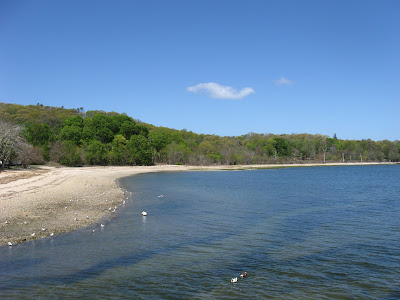

A view from Theodore Roosevelt Park. On this bright morning there were several terns, numerous gulls and many other birds in the areas actively feeding. Image copyright Daniel E. Levenson 2013.
I finished up the day back the Theodore Roosevelt Sanctuary and Audubon Center where I met Wildlife Care Coordinator Alice Bryant who was standing near the center with a beautiful female Great-horned Owl. She explained to me that the bird had arrived recently from California and had a problem with its eyesight. I was happy to learn that at the center the owl would receive some much-needed eye care and also serve to help teach visitors about birds of prey. Seeing the owl up close was an amazing experience - I've heard these large predators calling at night, but until then I had never stood so close to one. It's a remarkable thing to see how dedicated staff and volunteers at places like the TR Sanctuary are not only saving the lives of injured wildlife but enriching the experience of visitors. I can't imagine how anyone would not want to learn more about such a magnificent creature (and hopefully feel invested in protecting it and its habitat) after seeing this sharp-beaked, bright-eyed animal up close.

A sign welcomes visitors to the Theodore Roosevelt nature Sanctuary. Image copyright Daniel E. Levenson 2013.

A female Great-horned Owl sits patiently on the gloved hand of Alice Bryant, Wildlife Care Coordinator at the Theodore Roosevelt Sanctuary and Audubon Center in Oyster Bay, New York. Image copyright Daniel E. Levenson 2013.

Overall it was a great weekend to be outside and explore a new area. I wouldn't say that any of the places I went should be thought of as birding hotspots, but in the case of Sagamore Hill the landscape alone was worth the visit, and although I didn't add any year or life birds, I did manage to add 5 or 6 new species to my New York state life list and I got to enjoy one of the best two days of the year so far, out in the woods and along the water, among the birds.

Thanks for reading.

In the Area


Regular visitors to the New England Nature Notes blog may notice that I am now adding a new section to some of the posts with helpful hints about places to eat or check out if you happen to visit the areas I write about. All of these recommendations are based on my personal experiences there and are meant as reviews.

On the Road

If you're traveling south from New England to get to Long Island and want to stop at a classic New York deli (which happens to be located in Vernon, Connecticut) you may want to stop in at Rein's Deli, conveniently located off of exit 65 from Route 84. My personal favorite is corned beef and turkey on rye with a side of potato salad and a black and white cookie for dessert. On this trip I also tried their potato knish which was pretty good and not too flaky which made it relatively easy to eat while driving, without making a mess. They also have great pickles and a selection of frozen gluten-free foods. In my opinion, definitely worth a stop if you're passing through Connecticut.

In Woodbury, NY

In Woodbury itself I found a few great places to eat, including Gaby's Gourmet Bagelatessen, located at
8025 Jericho Turnpike. I walked into this place on Sunday morning and was really impressed with how fresh everything looked, from the pre-made salads to the bagels and bakery items. I went for a sesame bagel with cream cheese and in the interest of scientific comparison, a black and white cookie. The Rein's cookies are good, and nothing beats the ones you can get in Manhattan, but I would definitely give the Gaby's black and white cookie an 8.5 out of 10 on the black and white cookie scale - the cookie part had the right consistency and the icing was excellent. 

I also visited the On Parade Diner for dinner on Saturday night, ordering chicken parmigiana to go. I was tempted to stay and eat there, but after a long day of birding I was eager to get back to my hotel and rest. The meal came with a side salad (nothing special) and bread (pretty good) as well as bread sticks and crackers. The chicken itself was very good, lightly breaded and moist inside and the penne was good also. They have a very diverse menu and friendly staff, so if you're in the area and looking for comfort food at the end of the day you should check out this diner, I know I plan to go back the next time I'm in the area.

For lodging I stayed at the Best Western in Woodbury, located at 7940 Jericho Turnpike in Woodbury. For the price ($130/night, plus tax, booked online) I thought this place was a good deal - the front desk staff were pleasant and helpful, and the room itself was clean and comfortable with a refrigerator, microwave, flat-screen TV and complimentary tea and coffee. I didn't take advantage of the free breakfast ( I had birds to see!) but it definitely smelled appetizing as I was checking out in the morning.

Copyright Daniel E. Levenson 2013.


Friday, May 3, 2013

Two more species bring my big year birding list to 121 species

After such a long and cold winter it felt amazing to be outside today in the bright spring sunshine, under a perfectly clear blue sky, surrounded by birdsong. Today was one of those days where I wander along the trail stopping every once in a while just to appreciate how green and vibrant the natural world has become in the last two weeks. With so many plants budding and flowering the insects have returned, and with their presence many of the familiar warm-weather birds are back as well. I had a little time this afternoon after work to get outside, so I drove over to Broadmoor Wildlife Sanctuary in Natick, Massachusetts, where I managed to see 27 species of birds in a couple of hours, along with a few other surprises.


Spring comes to Broadmoor wildlife sanctuary in Natick, Massachusetts. image copyright Daniel E. Levenson 2013.
I started out by visiting the marsh along the boardwalk, where a number of Eastern painted Turtles were out basking on half-submerged logs. There were also plenty of nosiy Red-winged Blackbirds and Common Grackles calling from trees along the edge of the water and from within the marsh itself. As I was watching the blackbirds I spotted a pair of Canada Geese on a nest and looked up to see two Wood Ducks come careening down toward the water, their nervous call echoing out as they disappeared into the vegetation. One of these days I plan to spend some time learning to ID the most common local plants beyond Skunk Cabbage and Poison Ivy. Today I spent some time taking photos of plant life that caught my eye and I would certainly welcome any assistance in ID'ing the plants in the photos below.

A plant emerges from the marsh. Image copyright Daniel E. Levenson 2013.

New plant life in the marsh. Image copyright Daniel E. Levenson 2013.

With the trees and other plants in bloom both insects and birds are re-appearing after a long winter. Image copyright Daniel E. Levenson 2013.

As I left the shade of the pine woods I came out into the sunlit open fields and decided to walk through the old orchard, one of my favorite spots in the sanctuary. It's a marvelous, sunny, open and rolling stretch of land with what looks like shrubland to me on one side, and grassland on the other. It's a great place to look for flycatchers, Eastern Bluebirds and a variety of other species. This afternoon I spotted my first Eastern Kingbird of the year in this area, bringing my New England birding big year total to 120 species. As I was about to turn and keep going something caught my eye in the distance at the far edge of the field, and I looked carefully through my binoculars, scanning the area. At first I thought it might be a fox or coyote, but I was very happily surprised to see that it was in fact a Fisher, a fairly common but rarely seen member of the weasel family.

A former orchard and the surrounding woods and grassland provide important sources of food and shelter for Eastern Bluebirds, Tree Swallows and other species of birds. Image copyright Daniel E. Levenson 2013.
I finished up the afternoon by adding one more bird to my New England birding big year list - a beautiful Eastern Towhee singing from the top of a dead branch at the edge of the orchard. I heard the bird before I saw it, and was excited to follow the sound of its song until I got a clear view of it perched at the top of the tree. Between the weather, the kingbird, the towhee and the Fisher, I would have to say that today was a pretty great day to be outside.


Copyright Daniel E. Levenson 2013.