Monday, December 24, 2012

Field Testing the BirdLog App at Stony Brook WLS

In the winter geese, ducks and other water birds will seek open places in the ice in wetlands and ponds. Image copyright Daniel E. Levenson 2012.
I suppose when it comes to technology I am what people might term a "late adapter," however ,when I find something useful I tend to embrace it eagerly. I rarely go afield without my digital camera, for instance, and I've been using my smart phone to keep birding lists using the note function for a while now.

So I was intrigued when I logged into e-bird recently to enter a list and noticed that they were featuring a new app called birdlog, which allows birders to keep track of field observations in real time and syncs with the ebird website. For $4.99 I thought it was worth a try, so this morning I downloaded the app and tried it out this afternoon during a short trip to Stony Brook Wildlife Sanctuary in Norfolk, Massachusetts.

Black-Capped Chickadees like the one pictured above are frequent visitors to backyard bird feeders throughout the winter months. They will often join mixed foraging flocks along with Tufted Titmice, Nuthatches and other birds. Image copyright Daniel E. Levenson 2012.
The weather was very nice - a slight breeze and partly cloudy skies, warm enough to go without gloves, and the moment I got out of the car I could see a lot of activity near the bird feeders beside the nature center. I immediately began to scan that area, noticing a vivacious flock of Black-capped Chickadees, Tufted Titmice and American Goldfinch. As I got closer I noticed Juncos had joined the mix, flashing their distinctive black and white tails as they moved from branch to ground and back again in search of seeds. I love to watch the activity and interactions between species at feeders, and the staff at Stony Brook does a great job of keeping their feeders stocked throughout the winter, attracting the usual suspects as well as Downy Woodpecker, House Finch, American Gold Finch, and Red-breasted Nuthatch.

As I walked down the trail, heading toward the boardwalk, I noticed an impressive level of motion and birdsong evident along the path. From behind stone walls, inside brush piles, and along the bare branches of deciduous trees I saw several active White-throated Sparrows and brilliant red Northern Cardinals. 

As I was enjoying this informal chorus of avian arias I saw something very large land on the trail ahead of me, just beyond the far edge of a wooden footbridge. I raised my binoculars quickly and confirmed my suspicions, as a Great Blue Heron came into focus. The bird was soon spooked by a loud group of people coming up from behind me, but it landed on a nearby rock sticking up out of the water. While much of the surface of the ponds was covered in a thin layer of ice, the heron soon made a rather ungraceful lunge for one open spot and managed to catch a bright green and yellow sunfish in its bill. It was thrilling to watch, and of course very surprising to see a Great Blue Heron still hanging around eastern Massachusetts. I've seen sporadic reports on e-bird of sightings, but I have definitely never seen one this late in the season before.

This Great Blue Heron was an unexpected sight so late in the year at Stony Brook Wildlife Sanctuary, by this time of year most herons have headed to warmer climes for the winter. Image copyright Daniel E. Levenson 2012.
The heron was still there when I left about an hour later, perched on large rock in the pond. I imagine it might hang around for a while if temperatures remain tolerable and there are some open spots where it might be able to catch fish. I would be very curious to know what the latest/earliest records are for this species in Massachusetts.

Out along the boardwalk I could see that most of the ponds were covered with ice. The resident Mute Swans were visible, along with two separate groups of Canada Geese, but aside from a small flock flying overhead I didn't see any ducks.
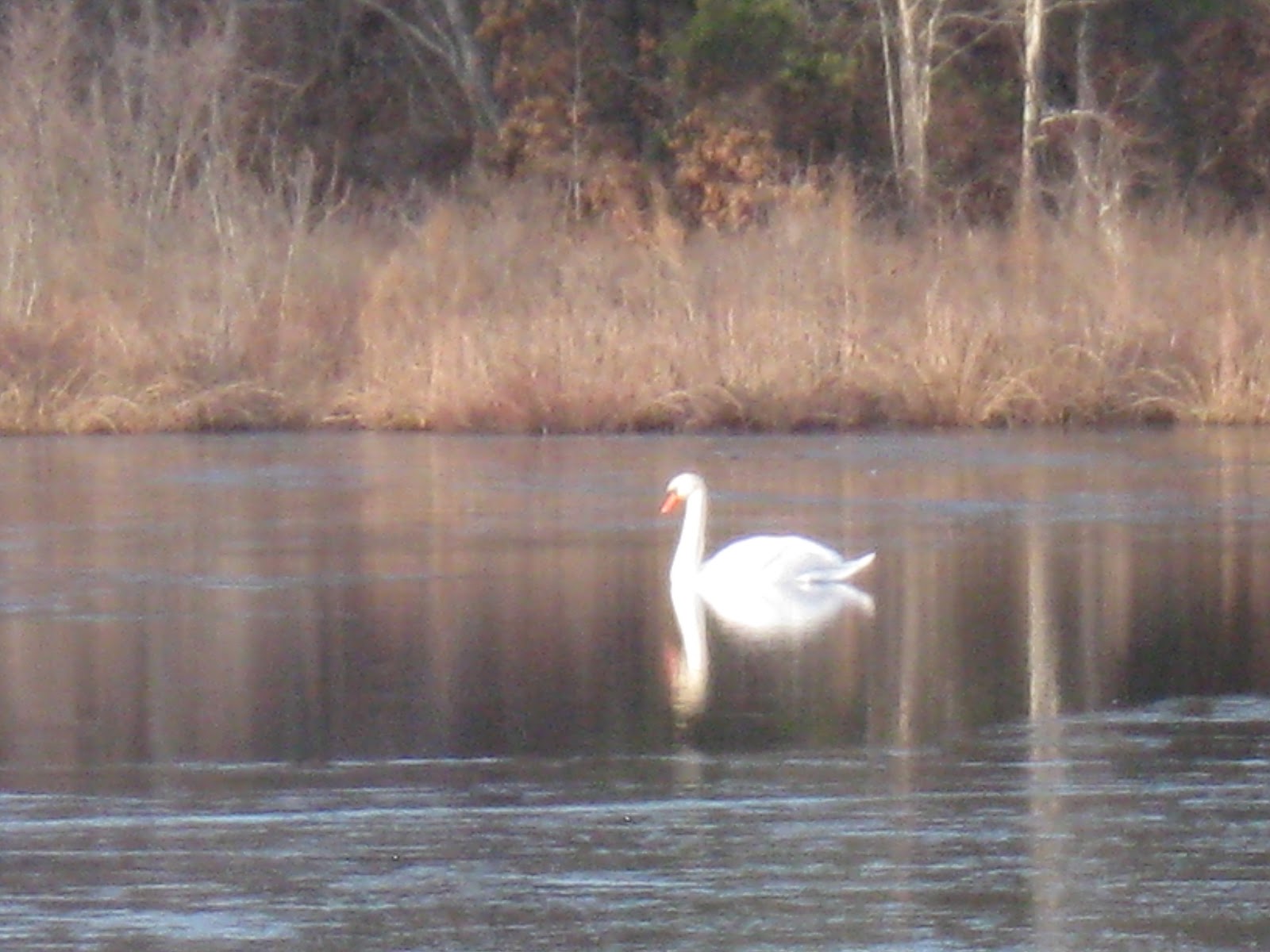
Mute Swans are native to Eurasia but have escaped from captivity in the United States where they have established breeding populations. Mute Swans are known for being particularly aggressive. Image copyright Daniel E. Levenson 2012.
I spent a while watching the Canada Geese try to navigate the uneven terrain created by thin ice on the pond - some of were able to walk along quite easily while others kept hitting soft spots and dropping through into the water below.

Canada Geese make their way across a pond at Stony Brook Wildlife Sanctuary. Thin, uneven ice makes for tricky footing as these web-footed birds move about. Image copyright Daniel E. Levenson 2012.
On the other side of the pond, just up a small hill, I was back in the action again, with Northern Cardinals, Juncos, Chickadees and others moving rapidly and calling loudly as they moved from branch to branch. As the afternoon warmed up a bit I looked up at the sky which was turning increasingly gray to try and discern what kind of weather might be headed my way, but the birds seemed undeterred by the unusual warmth or the potential promise of rain or snow. Back near the feeders there was even more activity, with one small group of Tufted Titmice moving at a frantic pace from trunk to branch to feeder, picking up seeds as they went. Beneath them, two American Tree Sparrows picked through fallen seeds, while two Downy Woodpeckers, one male, the other female, alternated between hammering away on a gray branch and checking out the feeder below.

Overall it was a great outing and I was pleased with the BirdLog app - my only concern is how much power it might draw from my phone, which could be an issue on longer outings, so I'll need to keep an eye on that. Otherwise it was a great asset in the field and as I think it will be a valuable tool as I attempt to tackle my Massachusetts big year in 2013.

In all I managed 18 species in about an hour and forty five minutes and got to enjoy the winter landscape. I don't think I could ask for much more.

Thanks for reading.

Copyright Daniel E. Levenson 2012.


Saturday, December 22, 2012

Glowing Clouds, Winter Ducks


Often the key to finding birds in winter is to look for them in places that offer resources they need -food and water - without being too exposed to predators or adverse weather. Image copyright Danuiel E. Levenson 2012.
With the wind sweeping open a few spots in an otherwise cloudy sky and the sun tinting the remaining clouds a glowing array of pink, blue and gray, today was a wonderful day to be outside. Yes, it was cold, yes it was a bit windy, but otherwise very nice. Around mid-day I found myself at Broadmoor Wildlife Sanctuary in Natick, Massachusetts, one of my regular birding spots and a favorite place in general to wander through woods, wetlands and fields.  The diversity of habitat in the sanctuary is a boon not just for birders, but anyone who might like to catch a glimpse of a deer, beaver or other wildlife.

In winter the setting sun paints the clouds in glowing tones of pink, yellow, blue and purple. Image copyright Daniel E. Levenson 2012.

In my search for birds today I found myself relying more on my own experience than on obvious external signs of avian life - scanning the tree tops looking for mixed foraging flocks of Chickadees, peering into quiet corners of the pond for the tell-tale ripples sent out by dabbling ducks, pausing beside brush piles to see if any sparrows were about. Which is not to say the woods were entirely quiet - there was occasional birdsong, and the maniacal chatter of both red and white-breasted nuthatches led me to at least two groups that contained two nice surprises: a Golden-crowned Kinglet and my very first Brown Creeper in Massachusetts (and only my second life sighting). Besides the few birds who did make their presence known through song there was also the occasional rush of the wind through the tops of towering pine trees and the unnerving creaking of dead trees rubbing against one another.

Another delightful discovery was a small group of American Wigeon feeding near a much larger group of Mallards. This was a new life bird for me, bringing my lift list to 194 and my year list (including New York and Connecticut) to 89. With the end of the year a little more than a week away I'm still hoping to crack 90, but we'll see.

On my way home I decided to stop at a local park where I often see a Red-tailed Hawk or two and where a group of Green-winged Teal have been hanging out for the last few weeks. On both counts I was successful, observing a Red-tailed Hawk perched high atop a building nearby and the group of teal were still present, actively feeding in a small pond. Among them was another bird which has been here for a while now, a solitary male Eurasian Teal. I still don't know where this stands in terms of being a separate species or subtype, but however it is classified this male was clearly quite different from the other males, with an easily visible white  horizontal stripe  running along the side of his body. I was also keeping en eye out today for  Crossbills and Grosbeak of various species, which have been reported  in the e-bird rarity alerts for Massachusetts as well as in the bird sightings section of the Mass Audubon website. Perhaps I will have better luck next time.


Copyright Daniel E. Levenson 2012.


Sunday, December 16, 2012

Last Flickers of Autumn

With the last days of Autumn at our doorstep, I find myself contemplating the coming cold. Despite a few strangely warm days this past week, when I stepped outside this morning I could feel that winter wasn't very far away. So under gray skies I decided to check out a few of my regular spots in Newton, hoping to find a little color and motion in a landscape otherwise rapidly sliding toward its seasonal slumber.

In one favorite haunt of mine I was surprised as a group of 4 ducks on the wing seemed to be as they circled over head, to notice that some of the smaller ponds had frozen over, while all along the water's edge Black-capped Chickadees, White-breasted Nuthatch, Juncos, House Sparrows and American Goldfinch moved rapidly from one spot to another between the brush and evergreens. Overhead, I spotted a couple of American Crow and two Blue Jays, all calling raucously in flight, while three Northern Flicker sat silently in the skeletal arms of a maple tree.

In another favorite spot I came across a boisterous flock of American Robbins who were soon joined by a group of European Starlings, transient transplants, cutting the cold gray air with their triangular wings. Like all animals, birds make changes in response to season and weather, and I have little doubt that the robins were on the lookout for late season fruit and berries.

In the winter the American Robin changes its dietary focus from insects to fruit. One way to find robins in winter is to look along the edges of fields and wetlands for fruing plants. Image copyright Daniel E. Levenson 2012.

As I was scanning the brush by one of the open ponds I met two other birders who were out as part of the Christmas Bird Count. We chatted briefly and they told me they had seen a Pine Siskin in a nearby park, and pointed out a Northern Mockingbird perched at the top of a tall tree. Again I was reminded of the amazing advantage of birding with other people - it seems like different people will always notice different birds. While we stood there I also spotted a female House Finch mixed in among a group of House Sparrows.

The real prize of the morning, in addition to the flickers, was a continuing group of American Green-winged Teal, which have been seen in Newton for the past few weeks.  Seeing them dabbling beside a small group of Mallards provided me with an excellent opportunity to study them beside this other very common duck.Although the Pine Siskin eluded me it was still a great morning to be outside and I hope to get back to the Newton City Hall pond soon with my camera to take some photos of the Green-winged Teal, which I'll be sure to share here on the blog.

Copyright Daniel E. Levenson 2012.


Saturday, December 15, 2012

To Ramble Across Meadow, Forest and Marsh: Contemplating a Massachusetts Big Year

Each night when I check my email one of the first messages which pops up is the e-bird rarity alert list for Massachusetts. I always open this email right away and scan the sightings to see what kinds of strange or unusual birds might have made their way to the Commonwealth, and I have to admit that as I do this, there is part of the that wants to seek out these birds - whether they are rare vagrants like the lapwings that have been sighted on the south shore recently, following Hurricane Sandy, or late-season birds that have somehow stayed behind, such as the reports of Barn Swallows I've been seeing lately. And then of course the list can be useful for tracking the arrival of rare but regular visitors, especially this time of year, when I am keeping an eye out for Snowy owls and Pine grosbeak, two species I have yet to add to either my state or life list.

In summer, the vibrant and verdant fields and forests of Moose Hill Farm prove irresistible to breeding Bobolink, Baltimore Oriole and a wide range of other bird species. Image copyright Daniel E. Levenson 2012.


Looking back over the past year there are definitely some sightings I have been excited about. Although my total number of the species was well below what I had hoped for, with 88 species of birds in New England and New York, I did manage to add 12 new species to my life list, including Northern Shoveler and Brown Creeper in New York's Central Park early last January. As the year progressed, I wandered many of my usual haunts, including Mass Audubon Broodmoor Wildlife Sanctuary where I added a Pied-billed Grebe in March and a gorgeous Green Heron to my list in May.  In a park in Newton, MA I added an Orchard Oriole and Brown Thrasher to my list, while trips to the Connecticut shore, Cape Cod and Plymouth Harbor added Great Shearwater, Wilson's Storm Petrel, Common Tern and perhaps most unexpectedly, Helmeted Guinea fowl, to my life list. The last new species to join both my year and life list so far was a Palm Warbler, which I spotted at the end of September at Broadmoor. Of course there is still some time left in 2012, so perhaps I will be lucky enough to add a few more names,

Massachusetts offers all kinds of great places to look for shorebirds, sea ducks and gulls. Above, a sandy stretch of beach in Barnstable, MA. Image copyright Daniel E. Levenson 2012.
But with January only two weeks away, I have to admit that those emails from e-bird have me thinking about attempting a Massachusetts big year. It's a notion I've been kicking around for a little while now, and one that my girlfriend Joanna has been encouraging. I don't enjoy listing for its own sake, but I do like to be able to look back and recall the time spent outdoors in pursuit of catching a glimpse of wild, feathered life. And there is a little of the spirit of the hunt to it as well, the thrill of pursuit. It strikes me as a romantic notion, to read about the presence of a Sandhill Crane or a Brown Pelican having mysteriously arrived in the Bay State, and then to go off and pursue it, to insert a little avian adventure into the day. Based on the little research I have done, it seems possible for an active birder to chase down around 400 species in one year in massachusetts, depending, of course, on a whole range of unpredictable factors - weather, climate change, work and family, etc. I also love the idea of seeing new places in a state I have called home for most of my life, of seeking out new wetlands, forests, meadows and shorelines to see not only the bird life there, but to experience the sun, rain, snow and tides that these places have to offer. The truth is that such an endeavor is really an excuse, a reason to explore. In eastern massachusetts alone there are dozens of places I have meant to visit a hundred times and never gotten out to see - this project is one way to finally get out there.

Stony Brook Wildlife Sanctuary in Norfolk, MA offers quiet trails and beautiful views of ponds and wetlands. Visitors to this Mass Audubon sanctuary can expect to find an impressive level of avian diversity among the wooded glades, hushed pine groves and sprawling wetlands and meadows. Image copyright Daniel E. Levenson 2012.

It's the totality of the potential experience that appeals to me, and that is what I intend to try to capture and chronicle here on my blog. Even if I only get half the number of species I aim for, I'm excited by the idea. And whether my first bird of 2013 is House Sparrow or a Snowy Owl, I look forward to sharing these moments of discovery with anyone who would like follow this journey here on New England Nature Notes.

Copyright Daniel E. Levenson 2012.


Tuesday, December 4, 2012

Late Autumn, In a Park and Along a Reservoir

Although the late Autumn landscape can look a bit bleak - caught between the golden-hued foliage and crisp, clear days of October and the bright, snowy winter mornings  yet to come - this is actually a fantastic time to get outside and explore. While it is true that fewer species of birds are around at this time of year, for birders the lack of leaves and thick vegetation provide an opportunity to get a closer look at the avian life which is around. I was reminded of this during two recent outings, the first was in Hartford, Connecticut, where I walked part of the way around a large reservoir over the Thanksgiving weekend. The weather was nice, warm even, for November, and the  placid water in front of me proved irresistible to a large number of gulls, Canada geese and, to my delight, a raft of Ruddy Ducks, which came quite close to shore as they disappeared beneath the water and popped up again, searching for food.

 
A reservoir in Hartford, Connecticut offers spectacular views and the opportunity to see Ruddy Ducks, Canada geese and other water-loving birds. Image copyright Daniel E. Levenson 2012.
During my walk at the reservoir I was also happy to spot several Juncos hopping around near some brush. According to the various guides I have consulted these vivacious little black and white members of the Sparrow family are present in New England year-round, but I've only seen them in the winter. The humble Junco holds a special place in my heart as it was one of the first birds I learned to recognize when I started my amateur birding career.

A little closer to home, this past weekend I stopped in at a favorite spot in Newton, Massachusetts, where the limited vegetation was immensely helpful in spotting a Red-bellied Woodpecker as well as a group of Green-winged Teal which have been hanging around this area for at least a week and a half now. Mixed in with the Green-winged Teal was a solitary male Eurasian teal. I have to admit some confusion here as to whether or not these are currently classified as two distinct species - ebird would not allow me to put in this bird as a Eurasian or Common teal, but I have noticed in the daily rarity report email that other people have been able to record their sightings (of what I believe is actually the same individual bird) as a Eurasian Teal. In any case, both species/variations are quite beautiful, and I was excited to see them.

Although parks and woodlands can look bleak in late Autumn it's worth remembering that wildlife, including many species of birds, are still present in the landscape. Image copyright Daniel E. Levenson 2012.

In the past I haven't usually gone out of my way to chase reports of rare birds that I've read about online, but as I look at my year list, which currently numbers 88, I can't help but feel a little bit like chasing after something unusual in the closing days of the year. After all, with the trees bare and wintering ducks and owls returning, this is probably the perfect time for me to head outside and try to see something unusual.


Copyright Daniel E. Levenson 2012.

Sunday, November 18, 2012

A Lesson in Closer Observation

Yesterday I managed to get outside for a little while and do some birding - something I haven't had much time to do lately. The weather was beautiful, a clear, sunny autumn day with just enough chill in the air to remind me that winter is around the corner. Because I was a little short on time I decided to check out a spot in Newton where I have seen close to 70 different species of birds over the last few years - the park in and around Newton City Hall and the loop around Bullough's Pond. The latter has been an especially good spot in the fall and winter for Common and Hooded Mergansers and in the warmer months I routinely see Great Blue Herons, Cormorant and Belted Kingfishers along the water's edge.

I decided to take a close look around the wetlands and stream by the city hall park and was rewarded almost immediately with a sighting of a large flock of dabbling ducks feeding in the middle section of the stream. At first glance I thought they might be Mallards, but I quickly realized they were not and was very excited to realize I was looking at a group of a dozen Green-winged Teal. A few years ago I observed a Eurasian Teal in the same spot (and others noted its presence as well) but this was, as far as I can recall, my first sighting of regular Green-Winged Teal in this location. The birds seemed relatively calm as they made their way across the surface of the water, pausing to tip the front half of their bodies forward as they foraged.

I later encountered a small group of Mallards with another male teal mixed in - It's possible this bird was a Eurasian Teal, since someone reported seeing one in the same location on the e-bird rarity alert list for yesterday. Yet another reminder of the importance of not rushing or jumping to conclusions, and as always, to carefully study the field marks of individual birds,

As I was getting ready to leave I spotted an odd airborne animal moving in rapid , erratic circles over the water. As I peered through my binoculars I was quite surprised to realize I was looking at a bat - this was definitely my first day-time sighting of these winged mammals, and I was surprised to learn after doing a little research that it is in fact not unheard for these normally nocturnal creatures to make an appearance in the daylight. This particular bat clearly appeared to be feeding on flying insects. I watched it for a while and even got a fairly good look at it through the binoculars.

Once again I was reminded of the importance of close observation and of patience - the two most important things we can bring into the field when trying to learn from nature.

Thanks for reading.

Copyright Daniel E. Levenson 2012.

Monday, August 6, 2012

Cottontails, Chimney Swifts and August

The edges of fields are a great place to look for birds which have begun their fall migration. Be sure to check all levels of vegetation, from underbrush to tree top. Image copyright Daniel E. Levenson 2012.

This evening some of the heat and humidity subsided, so I decided to go outside for a little while and see what birds might be around in a park in Newton, Massachusetts. I've been reading a great book recently - Kenn Kaufman's Field Guide to Advanced Birding, which puts a lot of emphasis on studying individual birds quite closely to sharpen field ID skills.The author writes at length about the importance of understanding the placement and structure of feathers, bird anatomy and physiology and learning to recognize other key traits that can help lead to more accurate identification of birds seen in the field. This evening there was not a lot of activity at the park, but I did manage to see about 10 or so species of birds that I could ID, along with two probably Solitary Sandpipers, a species I have seen several times before at this location. One of my favorite finds for the evening was a single male American Goldfinch, which was perched at the end of a long, bare branch at the top of a tree. I was scanning the treetops when I spotted it, standing quite still in the evening light.

With rain in short supply this summer, many wetlands and streams are suffering. In this photo two female mallards move between mudflats and a shallow stream, looking for food. Image copyright Daniel E. Levenson 2012.
In the course of my wandering, I also saw several mammals, including a gray squirrel, two muskrat and several cottontail rabbits.When I got home I was curious to learn a little more about what kind of rabbits I might have seen, and was surprised to learn that there are actually two different cottontail species in Massachusetts - the Eastern Cottontail and the New England Cottontail,  but for all intents and purposes, they are impossible to tell apart visually.  I found this webpage on cottontails put together by the Massachusetts Division of Fisheries and Wildlife to be pretty interesting.

As I was looking in a semi-open area to see if there might be any Downy Woodpeckers or Black-capped Chickadees in the area, I came across a rather large fungus, which you can see in the photo below. I don't know much about fungi, so if anyone has any thoughts about what this might be, I would love to hear them,

A large and fungus at the base of a tree in a park in Newton, Massachusetts.

As I walked back to the car I paused to watch a group of Chimney Swifts high above me in the sky. Their distinctive rapid chirps floating down as they beat their tiny wings quickly, then glided in short swooping arcs, catching insects in the air. Maybe it was the fading light of a summer evening having an effect on me, but I couldn't help thinking as I watched them that in another few weeks they might already be gone, headed south for the winter.

Copyright Daniel E. Levenson 2012.